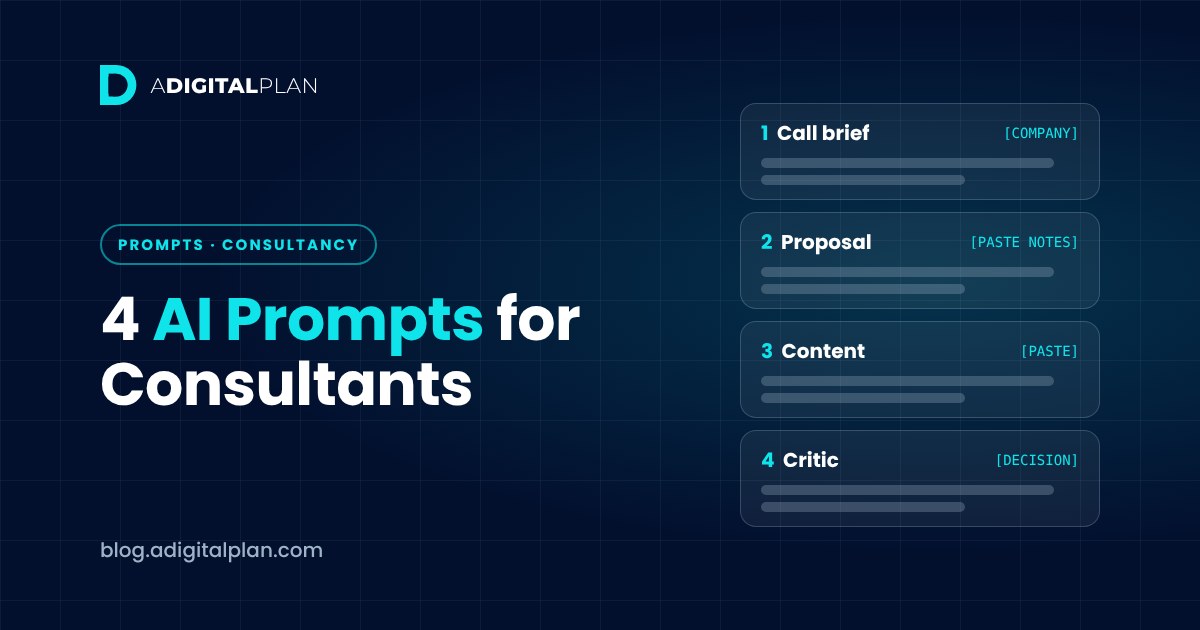
AI Prompts for Consultants That Do Real Work
The AI prompts for consultants that work are short, because the context sits underneath them: a knowledge base about your business and a set of rules the AI reads first. Below are four prompts for the jobs that pay (call prep, proposals, content and a second opinion), plus four extras for executive summaries, SWOT analysis, competitive analysis and customer segments.
That matters because a prompt is only as good as what the AI knows. The same prompt gives a generic answer in a blank chat and a useful one when your clients, offers and voice are already written down.
This list is for independent consultants, business consultants and small firms in any industry or sector, from beginner to expert. Copy each prompt, fill in the square brackets and adapt it to your own client work. They’re written for Claude, but they work in most AI tools.
Need the setup first? These prompts assume Claude already knows your business. Our free Claude course for consultants builds that in about 90 minutes. No card needed.
Start the free course →Why most prompt lists don’t work
Most prompt lists were written for someone else’s business. Paste one into a blank chat and you get generic output, because the prompt carries the instructions but none of the facts: who you serve, what you sell, your positioning and how you sound.
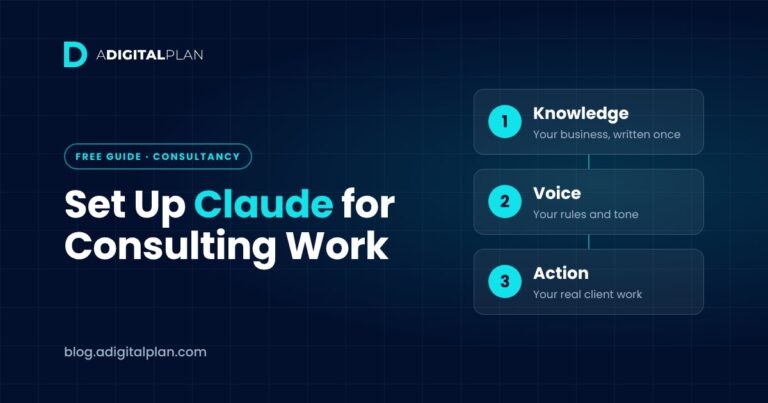
The fix is to put those facts in a Claude Project once. Then each prompt only has to say what you want this time, rather than trying to carry everything in a single prompt.
Before you use these prompts
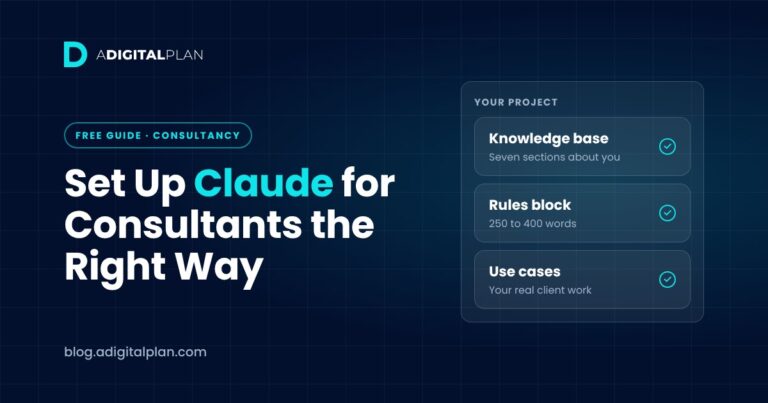
Each prompt assumes your Claude Project contains:
- A knowledge base: your clients, offers, pricing, positioning and the proof you can evidence.
- A rules block: your tone, writing style, format limits and a no-go list, including “never invent client names or figures”.
Without those, add the missing facts to the prompt each time, and expect more editing. The free course shows you how to build the knowledge base and rules block in about 90 minutes.
Prompt 1: Discovery call brief
I have a discovery call with [COMPANY] on [DATE].
Here is what I know about them: [PASTE THEIR SITE, NOTES OR LINKEDIN].

Using my knowledge base, give me:
1. Their likely situation in three sentences.
2. Their likely pain points and client needs, and which of my offers fits, and why.
3. Five questions to ask, in order.
4. The three objections they are most likely to raise, and how I would answer each.

Flag anything you are guessing rather than taking from what I gave you.
Follow-up: “Which of these questions would a sceptical buyer find annoying? Rewrite them.”
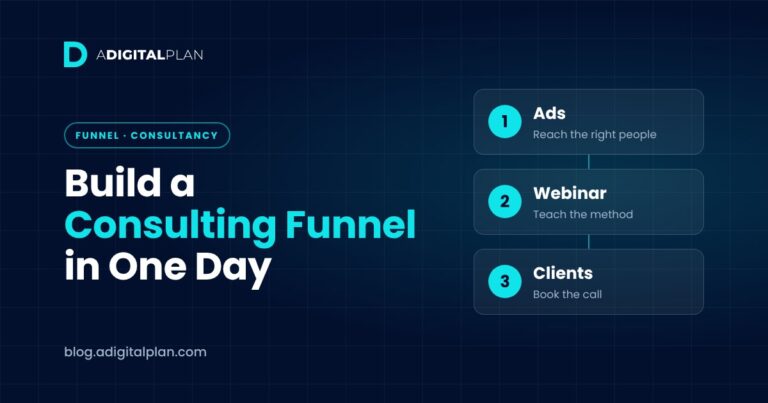
Need more calls to prepare for? Here’s how to build a consulting funnel in one day.
Prompt 2: First-pass proposal
Here are my notes from a discovery call with [CLIENT]: [PASTE NOTES].

Draft a first-pass proposal using only my offers and pricing from the knowledge base.
Structure: their situation, the value proposition in one sentence, what changes, the work, timeline, investment, next step.
Where my notes are unclear, write [CHECK: question] instead of guessing.
Keep it under 600 words.
Follow-up: “Read this as the client. What would make you hesitate to sign?”
Prompt 3: A week of content from one idea
Here is a talk, call recording or long post of mine: [PASTE].

Turn it into:
- three short LinkedIn posts, each making one point,
- one newsletter introduction,
- five topics I could write about next.

Use my voice from the knowledge base. No hashtags, no emojis, nothing I didn't say.
Follow-up: “Which of these sounds least like me? Rewrite it using my writing samples.”
Prompt 4: Claude as a critic
Use this for any decision making you’re unsure about, such as a change to your pricing strategy or which client to take on. It’s the prompt for critical thinking, not agreement.
I'm about to decide: [DESCRIBE THE DECISION, E.G. A PRICING STRATEGY CHANGE].
My reasoning: [EXPLAIN].

Don't agree with me. Tell me:
1. The assumption I haven't tested.
2. What would have to be true for this to fail.
3. The trade-offs I'm accepting.
4. The one thing I should check before committing.
Follow-up: “If you had to argue the opposite decision, what’s your strongest case?”
Four more prompts consultants ask for
These aren’t part of the course’s four use cases, but they work the same way: short prompts, with your knowledge base underneath. Each one only uses the data you give it.
Prompt 5: Executive summary
Here is a report or set of notes for [CLIENT]: [PASTE].

Write an executive summary for a senior, C-suite reader:
1. The decision they need to make, in one sentence.
2. The three findings that matter most, each with its source in the material.
3. The recommendation, and the main risk if they act on it.
Keep it under 250 words. Write [CHECK] wherever the material doesn't support a point.
Prompt 6: SWOT analysis
Using only what I give you about [COMPANY]: [PASTE NOTES, SITE COPY OR REVIEWS].

Build a SWOT analysis: strengths, weaknesses, opportunities and threats, three of each.
For every point, say what in my material supports it.
Then identify the key opportunities my offers could help with, and explain why.
Finish with the two actionable insights I should raise on my next call.
Don't add facts about their market or competitive landscape that I haven't given you.
Prompt 7: Competitive analysis and market trends
Here is what I've gathered about [CLIENT] and three competitors: [PASTE WEBSITES, PRICING PAGES, REVIEWS OR REPORTS].

1. Summarise how each company positions itself, in one line each.
2. List the competitive advantages each one claims, and what evidence supports them.
3. Identify the trends that appear in more than one source, and name the source for each.
4. Suggest two strategies [CLIENT] could test, with the costs and risks of each.
Use only the material above. Mark anything you inferred as [INFERRED].
If you use a research or deep research mode to gather the material first, check every source yourself before it goes into this prompt.
Prompt 8: Customer segments
Here is what I know about [CLIENT]'s customers: [PASTE SURVEY RESULTS, SALES NOTES OR REVIEWS].

Group the customers into three to five segments. For each segment:
- who they are and what they need,
- the factors that drive their buying decision,
- which part of [CLIENT]'s operations or offer serves them best.
Say which segment the evidence supports most strongly, and which is a guess.
Follow-up for prompts 7 and 8: “Which of these points would a sceptical client challenge first? What evidence would answer them?”
How to make any prompt better
The right prompts for client work share five habits:
- Ask for flags, not guesses. “Write [CHECK] where you’re unsure” stops invented details.
- Set a length and format. Without one, a four-line email becomes nine paragraphs of output nobody reads.
- Always ask a follow-up. The first draft is usable; the follow-up makes it sendable.
- Give it the data. For any analysis, paste the material in. Highly structured prompts can’t make up for missing facts.
- Fix the setup, not the prompt. If you keep adding the same context, it belongs in your knowledge base.
Frequently asked questions
Do these prompts work in ChatGPT?
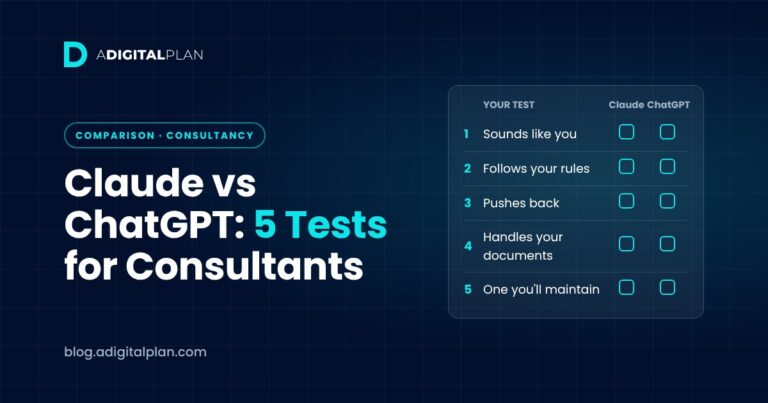
Yes, if ChatGPT has the same knowledge base and rules, so you can prompt ChatGPT with the same text. They’re written for Claude, which is what our course uses. See Claude vs ChatGPT for consultants if you’re choosing.
Why are the prompts so short?
Because the context lives in your Claude Project. Long prompts are usually a sign that the setup is missing.
What are some effective prompts to give Claude?
Short, specific ones that name the job, the format and what to flag. The four core prompts above, with your knowledge base underneath, cover most consulting work.
Will prompts make me think like a McKinsey consultant?
No prompt replaces experience. Structured prompts help you frame the question, lay out options and test assumptions, but the in-depth judgement about what a client should do stays with you.
Can Claude help me run my business?
It can draft, check and challenge your work, but you own the judgement. Nothing should go out unedited, and no number should go out without a source.
Can AI write my case studies?
Only from results you give it. Never let it fill gaps with figures, because invented proof is the mistake that reaches a prospect before anyone checks.
What about digital transformation or innovation projects?
The same approach works: describe the client’s current process, paste the facts you have, and ask for options with trade-offs. Keep confidential client data out of your prompts.
Which AI tools work best for consultants?
The one you’ll set up with your business and keep using. Most AI models can run these prompts; the difference is the context you give them. These prompts are written for Claude, which our course uses.
Get the full prompt chains, free
The free Set Up Claude the Right Way course gives you four prompt chains with their follow-ups, plus the knowledge base and rules block they rely on. Read how to set up Claude for consulting work for the overview. It’s 14 short lectures, about 90 minutes, free for life and suitable for everyone from beginner to expert.