Best Web Design Niches, and How to Choose Yours
The best web design niche is one you can list, prove a result in within 90 days and build for again and again with only small changes. No universal list of the best web design niches can tell you which one that is for you, because your way in and your proof depend on your own history.
This guide is for web designers, web developers and web design agency owners, from beginner to expert. It covers what a web design niche is, common niche ideas and what to check for each, and how to choose and test yours.
Want to pick a niche from your own work history? The free Claude prompt course for choosing an agency niche does the scoring with you in four short lessons. No card needed.
Start the free course →What is a web design niche?
A web design niche is the specific market your web design business serves: a particular kind of business, defined tightly enough that you could list them. “Independent physiotherapy clinics” is a niche. “Small businesses that need a website” is not.
Many web designers niche by style or tool instead, such as minimalist sites or one website builder. That describes how you work. A niche describes who you build for, and that’s what gives you a list, a message, proof that carries from one project to the next and expertise that builds up. Focusing on who, rather than how, is what turns a portfolio into a strategy.
Why web designers stay general
Most web designers accumulate a niche rather than choose one. They build whatever comes in, and after a few years the portfolio is a café, a law firm, a charity and a friend’s online shop.
Nothing is failing. Projects get paid. But nothing compounds:
- Every proposal starts from scratch.
- No case study helps the next sale, because the next prospect is in a different industry.
- The homepage describes a temperament, such as “beautiful, engaging websites for ambitious brands”, because nothing more specific would be true.
The usual fix is to pick a “lucrative niche” from a list. That tends to fail for a different reason: you start with no proof and no contacts, against other web designers who have been there for years.
Why repeatable matters most in web design
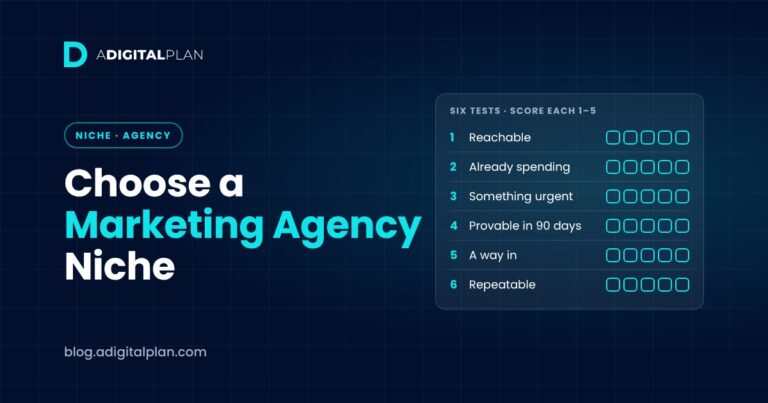
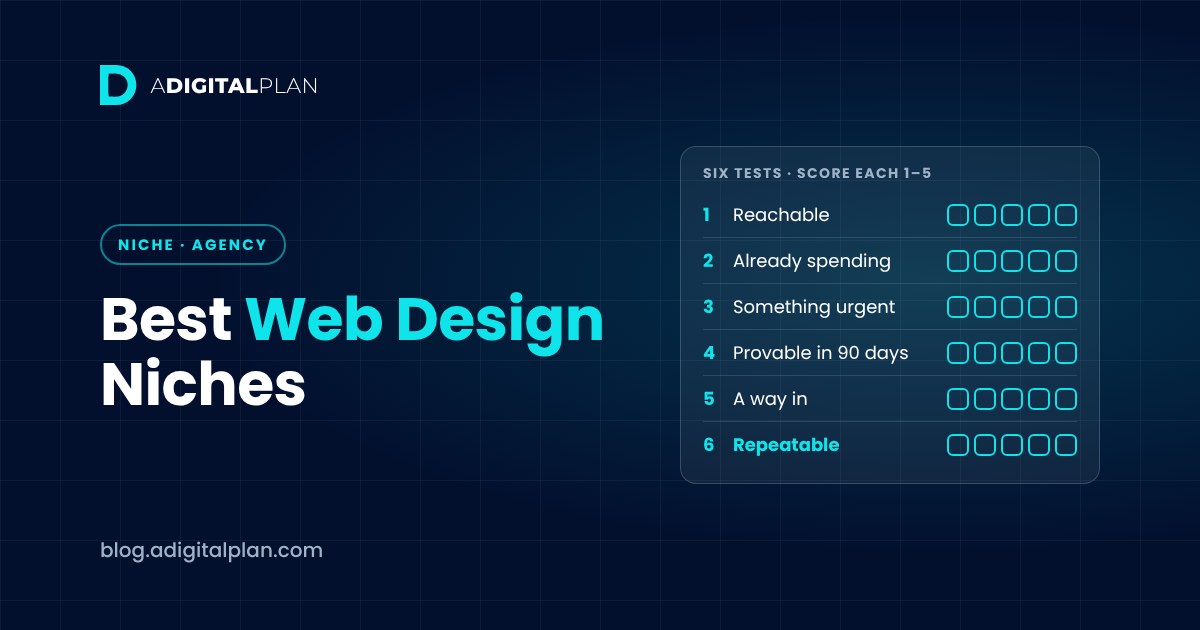
The course scores every candidate niche on six tests. For web design, test 6, Repeatable, often decides it. If every site is bespoke, you have a job, not a niche.
A good niche for web design is one where the second client buys roughly what the first bought: the same pages, the same booking or enquiry flow, the same integrations. That’s what lets you reuse what you built, price confidently and show a case study the next prospect recognises. Custom websites still fit: what repeats is the shape of the project, not the design.
The course demo shows this. Apex AI, a fictional agency 18 months in with six clients across four sectors, finds its niche not in the founder’s favourite industry but in its own client list: four clients with near-identical builds, proof in under 90 days and a public register it can list in an hour.
The six tests for any web design niche
Score each candidate from one to five. Never add the scores up: one fatal score kills a candidate.
- Reachable: could you list 200 of them without buying data? A niche you can’t list is a preference, not a market.
- Already spending: do they already pay for websites or something close? Redirecting a budget takes about two months. Creating one takes about two years.
- Something is urgent: does a visible event, such as a rebrand, a move or a new location, make some of them look this quarter?
- Provable in 90 days: could you launch a site and show one referenceable result inside a quarter?
- A way in: do you have prior work, a relationship, a background or a language a stranger wouldn’t?
- Repeatable: will the second client buy roughly what the first bought?
Reachable and Provable are the two you can’t work around. For more on each test, see how to choose a niche for your marketing agency.
Common web design niche ideas, and what to check
These are common ideas, not recommendations. The notes are what to check, not verdicts. Only you can score your own way in.
| Web design niche idea | Easy to list? | What to check first |
|---|---|---|
| Trades and home services | Usually | Whether enquiries come by phone or form, and who answers them |
| Dental and medical practices | Usually | Whether practices own their site or are tied to a group |
| Law firms | Usually | Who signs off the site: a partner, a manager or a committee |
| Accountancy firms | Usually | Whether firms of one size need roughly the same pages |
| Personal trainers and fitness studios | Usually | Whether a typical one has a budget for a custom site |
| Real estate agents | Usually | Whether the brokerage provides the site already |
| E-commerce stores | Depends | Narrow by platform or product type, or it’s too broad |
| “Small businesses” | No | Too broad to list. Narrow to one type first |
Trades and home services
Trades businesses are listed on map and review sites, so the list is quick to build. The builds often repeat: services, areas covered, reviews and a way to get a quote. The question is whether owners see a website as a lead source or a cost.
What to check: review sites, for what customers complain about, and how many local firms still run an old site or none.
Law firms and accountancy firms
Professional services firms are listed by professional bodies and registers, so they score well on reachable. Sites for firms of a similar size tend to need similar pages. Sign-off can be slow if several partners have to agree, which matters for test 4.
What to check: company filings and listings, to confirm firm size, and job adverts, which show whether firms are investing in marketing.
E-commerce stores
Stores spend on their sites and produce sales numbers you can measure. But “e-commerce” is too broad to pass as a niche. You’d need to narrow it to one platform, one product type or one size of store before you could list 200 of them.
What to check: whether you could name that narrower group and build the list this afternoon.
The project type I’ve built most often is websites for financial services firms. It’s very high-profit work, and the clients keep you on afterwards, because their sites have to stay compliant with financial rules and they need someone to keep them that way. That ongoing compliance work is what turns one build into a long-term client.
How to choose your web design niche
- Write your honest history (about 20 minutes). Every project, including favours and failures; freelance work; results you can reference; work you enjoyed and dreaded; and industries and interests you know from outside web design. That last group often produces the strongest candidate.
- Pull out five candidates. Each must trace back to a line in that history, with the unfair advantage you hold or an honest “none”. Name the one you’d pick for the wrong reasons.
- Score them against the six tests. One fatal score kills a candidate.
- Pressure-test the top two, then commit to one. Ask what would have to be true, and what work you’d turn down.
- Verify it in one evening. This research uses free public sources. Check job adverts, review sites, forums and trade press, and company filings and listings, then have two short conversations with people in the market. Decide in advance what result sends you back to your second candidate. Don’t change your website or LinkedIn first.
Define your web design target market
A niche gets you a list. An ideal client gets you a message. Your web design target market should be written in four parts:
- Business: size, revenue band, location, staff and how they sell now.
- Person: who signs, their day, what they’re measured on and who else agrees.
- Language: ten phrases business owners in the niche use, in their own words.
- Disqualifiers: three kinds of business to avoid, visible from outside.
For web design, the best signals are often visible on the prospect’s own site. “No budget” fails as a disqualifier because you can’t see it. “Still on a founder-built website after ten years” passes, because you can.
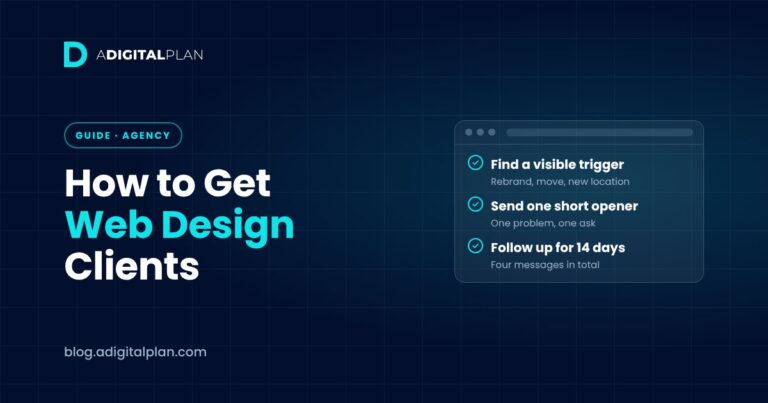
Then write one positioning line naming who you build for and what changes for them, so potential clients can see the site was meant for them. Next to it, list the projects you’ll now turn down. When the list is ready, here’s how to get web design clients from it.
Signs a web design niche will pay for good work
Whichever candidates you score, a few signals tend to separate niches that value a website from niches that see it as a cost:
- Each new customer is worth a lot. Law firms, accountants and financial services firms can justify a bigger investment in web design services because one new client matters to them. That’s why legal, finance and accounting work often comes up as higher-value.
- The site has to produce enquiries. Home services firms need lead-generation websites that turn visitors into phone calls and quote requests. You can measure that, which makes it easier to show return on the project.
- There’s an urgent, external reason. Compliance rules, accessibility requirements or a rebrand create a deadline the business can’t ignore. Check the rules that apply in your clients’ country rather than promising compliance yourself.
- The result shows up in numbers. E-commerce stores and software companies judge their sites by conversion rates and sign-ups, so a well-built landing page has a clear before and after.
- Looks matter to their buyers. High-end real estate and premium services need sites that look the part, which favours designers with a strong visual portfolio.
None of these replace the six tests. They help you judge test 2 (already spending) and test 4 (provable in 90 days) faster.
Other ways web designers niche
An industry niche isn’t the only option. Some web designers and web developers build their web design business around a service or a type of project instead. These can work, as long as the market behind them still passes test 1:
- A service niche. Speed and performance optimisation, accessibility fixes or ongoing website support and maintenance. The skill travels across industries, but you’ll need a clear way to find businesses with that specific problem.
- A project niche. Booking sites, membership sites or sites for people selling an online course or other digital products. What repeats is the build, which helps test 6.
- A sector with formal buying. Charities, schools and government agencies often buy through tenders or approved supplier lists. That can be steady work, but it’s a slower, different kind of selling, so check test 3 honestly.
Combining a service and an industry is often the sharpest option: “booking sites for physio clinics” tells potential clients more than either half on its own.
What focusing on one niche changes
The key advantages of choosing a niche show up in day-to-day work, not just in marketing:
- You reuse more. Page structures, content questions and integrations carry from one project to the next, so you spend less time creating websites from a blank page.
- You price with more confidence. When you know what a typical project in your niche involves, quotes are easier to write and easier to defend.
- You keep up with one industry. Following the trends, regulations and tools in a single market is realistic. Following them across ten isn’t.
- Your examples get more relevant. Each finished site becomes an example the next prospect recognises, which is what helps you win more clients in the long run.
Some designers worry they’ll grow bored building similar sites. If that’s a real risk for you, it belongs in Step 1 as work you’d dread, and it should count against a candidate before you commit.
Frequently asked questions
What is the best niche for web design?
There isn’t one best niche for every designer. The best one for you is a market you can list, have a way into and can show a referenceable result for within 90 days, where the second client buys roughly what the first bought.
What are the most profitable web design niches?
Lists rank niches by what businesses in them are willing to pay. That isn’t the same as what you can win. A profitable niche for you is one where your proof and contacts already point. A niche you can reach, prove and repeat will usually do more for you than a higher-value one where you have no proof and no way in.
Do I need a portfolio in the niche first?
No. Your history includes past projects, jobs and industries you know from outside work. Test 4 asks whether you can produce one referenceable result within 90 days, not whether you already have ten.
How do I know I’ve chosen the right niche?
It traces back to a line in your own history, you could list 200 named businesses this afternoon, at least one other candidate died on a single test, and you’ve run the checks, including both conversations.
Should I niche by industry or by style?
By industry, or by a specific kind of business. A style or tool tells prospects how you work, but it doesn’t give you a list of named businesses to approach.
Does choosing a niche mean turning work away?
Yes. Write down which projects you’ll turn down before you announce the niche, or the first off-niche enquiry in a quiet month will undo it.
Can SMMA and web design share a niche?
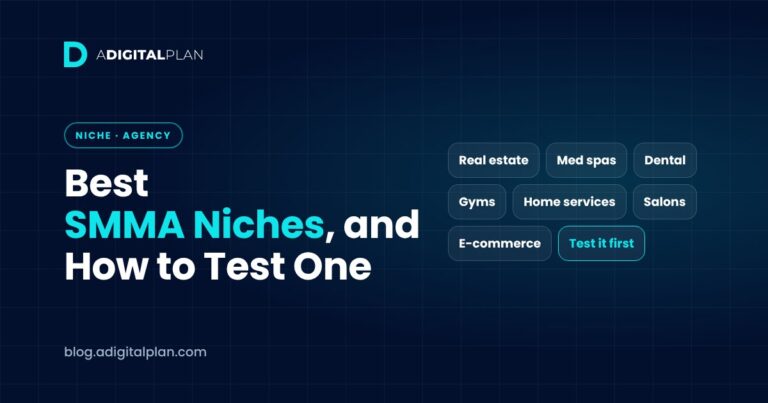
Yes, if the same market passes the six tests for both services. See the best SMMA niches and how to test one.
Choose your web design niche with the free course
The free Agency AI Niche & ICP Finder course gives you four lessons (three teaching lessons and a live demo), six plain-English Claude prompts, a prompt pack and an SOP. You finish with one chosen niche, a four-part ideal client and a positioning line, built from your own history. It’s free for life, needs no card and nothing to install, and suits designers and agency owners from beginner to expert.