How to Get Clients Without Cold Outreach (and When to Use It Anyway)
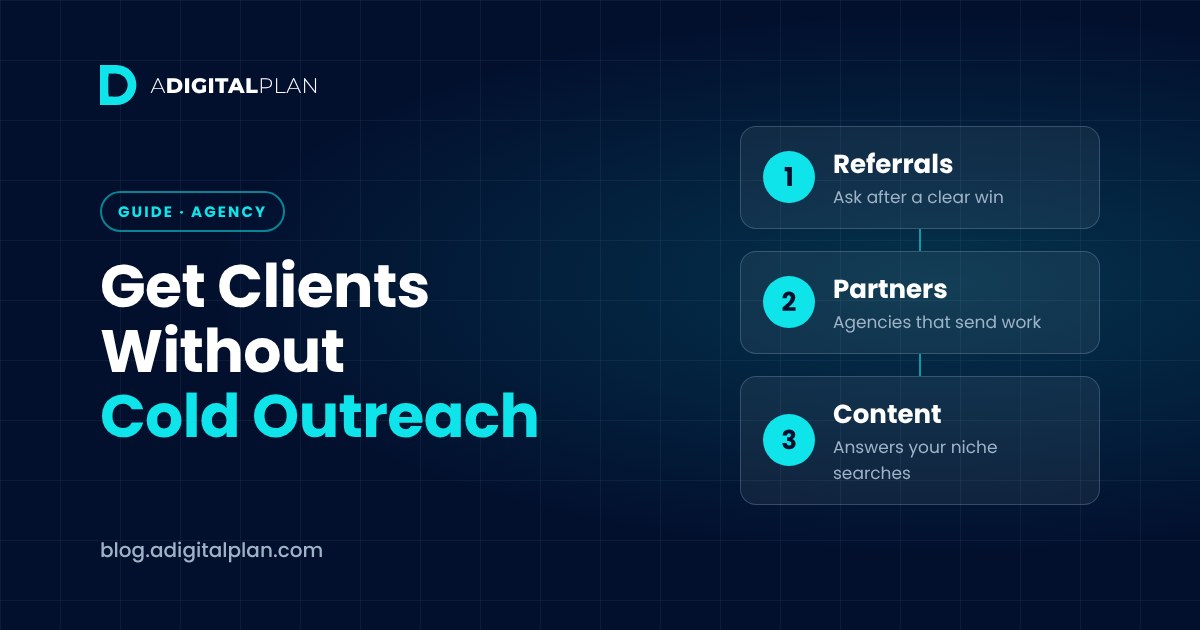
You can get clients without cold outreach through referrals, your warm network, partnerships, content and communities. Each works best once you have a clear niche and some proof; until then, a small amount of careful cold outreach is often the fastest way to your first real conversations.
This guide is for SMMA, marketing and AI agency owners, from beginner to expert. It covers five alternatives to cold calling and cold email, what each one needs before it works, and how to tell when cold outreach is still the right call.
If you do need cold outreach, the free course on doing cold outreach without spamming anyone shows how: twenty researched prospects, no bought lists and no sending tool. No card needed.
Start the free course →Why so many agency owners want to avoid cold outreach
Most cold outreach feels bad because most of it is bad. A vague list, a flattering opener about follower counts, a claim with no source and a single message that’s never followed up. It doesn’t work, so it feels like spam, and it often is.
So it’s natural to look for warm leads instead. The good news is that there are good alternatives. The catch is that each one needs something in place first. Knowing what that is tells you which route suits you now.
Five ways to get clients without cold outreach
1. Referrals and referral marketing
Referrals are often the warmest leads you’ll get, because someone the buyer already trusts has vouched for you. Referral marketing simply means asking for them on purpose rather than waiting.
What it needs: at least one happy client, and a clear description of who you help, so they know who to send your way. With permission, a short testimonial from happy customers also becomes social proof you can use elsewhere.
How to start: ask after a good result, while the win is fresh: “Who else do you know with this problem?” Name the kind of business you mean. Then make asking a habit, not a one-off, because referrals that rely on memory rarely arrive.
2. Warm outreach to your network
Warm outreach means contacting people who already know you: past colleagues, old employers, friends running businesses, family members and people from your previous industry. It also covers re-engaging past clients and old contacts you’ve lost touch with.
What it needs: an honest list of who you know, and one sentence that explains your offer: your value proposition in plain words.
How to start: write to ten people who know your work and ask for advice or introductions, not a sales pitch. A short, personal message is enough.
3. Partnerships with businesses that share your clients
A web designer, accountant or bookkeeper who serves the same businesses as you can pass work your way, and you can return the favour.
What it needs: a niche narrow enough that you can name your ideal partner. If you’re still deciding, start with choosing a niche for your agency.
How to start: list three businesses that sell to your clients before or after you do, and offer them something useful first.
4. Content marketing that shows how you think
Useful content, such as a blog post, a short guide or a video, lets potential customers find you and judge your thinking before they ever speak to you. Over time this brings inbound leads, and a simple free guide or checklist (a lead magnet) gives interested readers a reason to leave their details.
What it needs: time, consistency and a niche, because content for everyone attracts no one in particular. Your own website also needs one clear next step for visitors.
How to start: answer the questions and pain points your ideal clients raise on discovery calls, one at a time.
5. Communities, networking events and LinkedIn
Industry groups, networking groups, local networking events, online forums and LinkedIn are where your target audience talks about its problems. Networking works when it’s about relationship building, not collecting business cards.
What it needs: patience. Joining and pitching straight away rarely works, and neither does attending once and never following up.
How to start: pick one community your ideal clients use and contribute useful answers for a few weeks before mentioning what you do. On LinkedIn, a clear profile, regular and relevant activity, and personal connection requests (not pitches) make you easier to find and easier to trust. After any event or conversation, follow up within a few days.
In my own agency work, LinkedIn was the route that produced the most calls. Using Dripify to send connection requests and follow-ups, and Clay to research each prospect first, we booked around five calls a day. That’s automated outreach, so it only pays once your targeting and message already work by hand, and check LinkedIn’s current rules on automation tools before you start.
Warm outreach vs cold outreach
Cold outreach means contacting a business that has had no prior contact with you. Warm outreach means contacting people who already know you, or who have engaged with you in some way. Put simply, cold leads have never heard of you; warm prospects already have.
| Warm outreach | Cold outreach | |
|---|---|---|
| Who you contact | People who already know you | Businesses that don’t know you yet |
| What it needs | An existing network | A narrow niche and careful research |
| Scale | Limited by who you know | Limited by how many you can research well |
| Best for | Your first few clients | Filling the sales pipeline beyond your network |
Most agencies end up using both, across multiple channels, rather than relying on a single channel for lead generation. Warm outreach is often quicker at the start, but your network runs out. That’s the point where cold outreach, done well, becomes useful.
When cold outreach is still the right call
Cold outreach is worth considering when:
- Your warm network has run out. You’ve asked everyone who knows you.
- You’re starting out with no case studies. Content and referrals take time to build, and you need conversations now.
- You’re entering a new niche where nobody knows you yet.
- Your pipeline is too unpredictable. Referrals arrive when they arrive; outreach is something you can start this week.
If you’re a web designer, SEO or social media agency, the specifics differ. See how to get web design clients, finding SEO clients without guarantees and getting your first SMMA clients.
What makes cold outreach work instead of feeling like spam
Cold outreach rarely fails on the wording, so rewriting the same message rarely helps. It usually fails on one of four faults, best fixed in this order:
- The list is vague. A job title isn’t a reason for someone to care.
- The detail is decoration. Mentioning their follower count or founding year proves nothing.
- The claim has no source. One result you can evidence beats three impressive ones you can’t.
- It stops at message one, although most replies come later in a sequence of follow ups.
The fix is fewer, better messages. Pick twenty businesses you’d genuinely like to work with and research each one, and its decision maker, by hand on public pages, about four minutes each. Then send a short opener about one specific thing you noticed, followed by a four-message sequence over fourteen days. Sending more is almost never the fix. AI can write the messages, but the research has to be yours.
The Agency AI Cold Outreach Engine builds this with six plain-English Claude prompts, from defining your ideal customer profile to diagnosing a flat campaign.
Never use bought lists or scraped data, and don’t automate anything before it works by hand.
Frequently asked questions
What does warm outreach mean?
Contacting people who already know you or your work, such as past colleagues, clients and contacts from your industry. Because there’s existing trust, the conversation starts easier.
How do I get clients without cold calling?
For most agencies starting out, warm outreach to people who already know your work, followed by referrals once you have happy clients. Partnerships, content and communities take longer but compound over time.
Do cold emails still work in 2026?
Generic cold emails perform poorly. A short email built on a specific, checkable reason to contact someone still starts conversations. The difference is research, not volume.
Is cold emailing illegal in the USA?
The course doesn’t cover the law, so check official guidance before you send. In the US, start with the FTC’s guidance on the CAN-SPAM Act; elsewhere, check the marketing email and data protection rules where you and your prospects are based.
Do I need case studies before doing outreach?
No. A message can carry no claim at all and still work if what you noticed about the business is specific and true.
How many cold messages should I send?
Start with twenty well-researched prospects rather than hundreds of generic ones, and run the full fourteen-day sequence before judging the results.
Do outreach the right way, free
When the warm routes run dry, the free Agency AI Cold Outreach Engine gives you six plain-English Claude prompts, a research checklist that takes four minutes per prospect, and a four-message sequence where every message stands on its own. It suits agency owners from beginner to expert and needs no list, tool or case study. If you haven’t chosen your niche yet, start with the free Agency AI Niche & ICP Finder.