How to Choose a Niche for Your Marketing Agency
To choose a marketing agency niche, write down everything you have already done, pull five candidate markets out of that history and score each one against six tests. Then spend one evening checking the winner against public evidence before you change your website or LinkedIn.
This guide is for marketing, digital marketing and social media agency owners, from beginner to expert. It works whether you have ten clients, a few mixed ones or none yet.
Want to do it with Claude doing the heavy lifting? The free six-prompt niche and ideal client course walks through the whole process in four short lessons. No card needed.
Start the free course →What is a marketing agency niche?
A marketing agency niche is a specific market you choose to serve, defined tightly enough that you could list the businesses in it. “Independent dental practices” is a niche. “Ambitious local businesses” is not, because there’s no directory of ambition. This guide is about niche markets: who you serve, rather than which service offerings you sell.
A niche agency is different from a generalist one in four ways:
- Proposals build on each other. You stop starting every pitch from scratch.
- Case studies sell the next client. A result for one business is relevant to the next.
- Your homepage says something. It names who you help, rather than describing your temperament.
- Expertise builds up. Each job teaches you more about the same industry, so the learning curve shortens instead of restarting.
That focus is how a niche agency stands out from generalist competitors. Choosing a niche also means choosing what you turn down. That’s the part most agencies skip.
Most agencies accumulate a niche rather than choose one
Most marketing agencies never decide. They take whatever comes in for a few years, then count which kind of client they have most of and call that a niche.
Nothing about that is failing. Clients pay and the work gets done. But nothing compounds either. The agency stays a set of unrelated jobs, and from the outside it looks exactly like every other marketing firm.
The course names four reasons agencies stay general:
- They accumulated instead of deciding. The client list made the choice.
- They chose on aspiration. They picked a sector that sounded good, with nothing in their background pointing there.
- They averaged the scores. A candidate with one fatal weakness still looked respectable on the total.
- They never wrote down the no. So the first off-niche enquiry in a quiet month got a yes.
In my experience, most agencies start by taking on any client they can. As they grow, they find the areas that are high-profit and easy to service, and often those are the areas they least expected. One client started out generating leads for builders and ended up in financial services. Builders were willing to pay $50 per lead; financial services firms paid $500.
Step 1: Write your honest history
This takes about 20 minutes, and everything after it depends on it. Write down:
- Every client, including the small ones, the favours and the ones that ended badly.
- Freelance work from before the agency existed.
- Results you can reference, and whether you can name the client. Write “nothing yet” where that’s true.
- Work you enjoyed and work you dreaded.
- Industries you know from outside the agency: a previous job, a family business, a hobby you know deeply.
Don’t skip the last one. It produces the strongest candidate more often than the client list does.
No clients yet? You can still do this. Jobs, freelance work and industries you know from outside work all count. If you’re leaving a job to go solo, years in one industry is often your best starting point.
Step 2: Pull out five candidate niches
Turn that history into five candidate markets. Each one must trace back to a specific line you wrote. If you can’t point to the line, it’s something you read about, not a candidate.
For each, note the unfair advantage you already hold, or an honest “none”. That advantage is your real competitive advantage over other agencies: knowledge, contacts or proof a stranger wouldn’t have.
Then name the one you’d pick for the wrong reasons. Everybody has one.
Step 3: Score each candidate against six tests
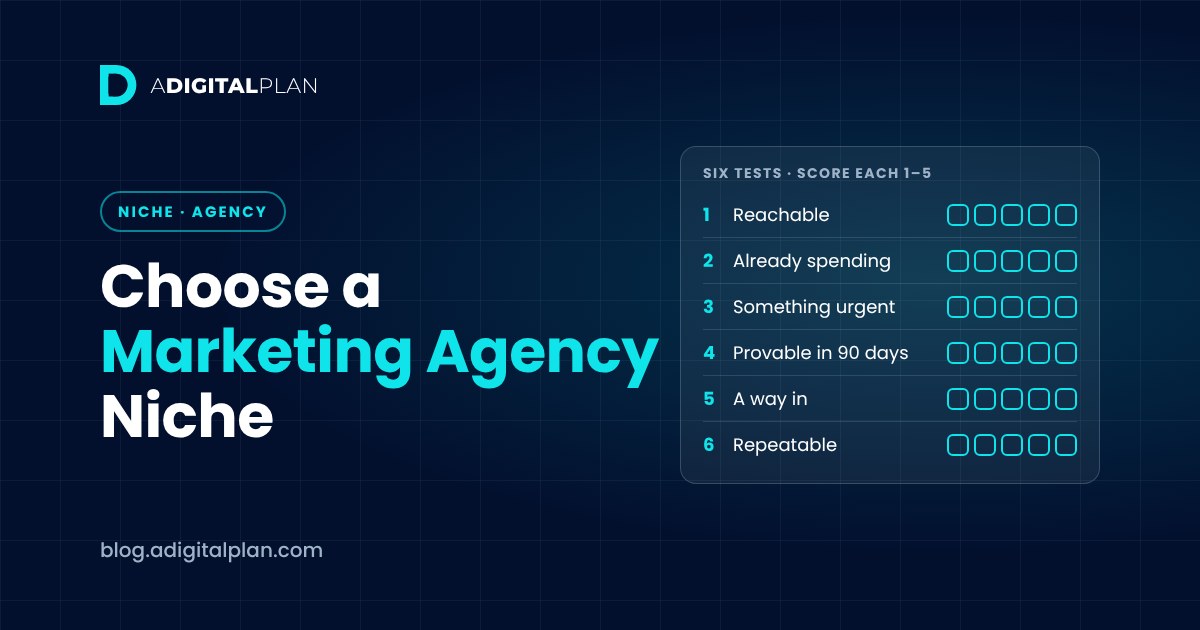
Score each candidate from one to five on each test. Never add the scores up.
| Test | The question | Why it matters |
|---|---|---|
| 1. Reachable | Could you list 200 of them without buying data? | A niche you can’t list is a preference, not a market. |
| 2. Already spending | Is there a budget for something close to what you sell? | Redirecting a budget takes about two months. Creating one takes about two years. |
| 3. Something is urgent | Does a visible event make some of them look this quarter? | Without urgency you’re selling improvement, which everybody defers. |
| 4. Provable in 90 days | Could you produce one referenceable result inside a quarter? | Proof is what the next sale runs on. |
| 5. A way in | Do you have prior work, a relationship, a background or a language? | Starting cold against specialists is the slow way in. |
| 6. Repeatable | Does the second client buy roughly what the first bought? | If every job is bespoke, you have a job, not a niche. |
One fatal score kills a candidate, whatever the other five say. Reachable and Provable are the two you can’t work around: you can’t fix a market you can’t list or a result you can’t prove in time.
A worked example: the favourite that lost
The course demo uses Apex AI, a fictional agency 18 months in with six clients across four sectors. The founder’s favourite is hospitality, after four years front-of-house.
Hospitality scores well on reachable and urgent. Then it dies: the one restaurant project failed, margins were poor and the build doesn’t repeat. The winner was already in the client list: four clients with near-identical builds, proof in under 90 days and a public register you can list in an hour.
Step 4: Pressure-test the top two, then commit
Take your top two and ask of each:
- What has to be true for this to work?
- What discovery in month four would mean you chose wrong?
- Who’s already there: generalist agencies, one dominant specialist or nobody?
- Who are the decision makers, and can you reach them?
- What work would you have to turn down?
Then commit to one. Running multiple niches “for now” is usually how the accumulating starts again.
Step 5: Verify it in one evening
Don’t rewrite your homepage yet. That makes reversing expensive. Spend one evening on six checks instead. Four use free public sources:
- Job adverts: are they hiring for work close to what you sell?
- Review sites: what do their customers complain about?
- Forums and trade press: what words do owners use, and what’s worrying them?
- Company filings and listings: are the businesses the size you assumed?
The other two are short conversations with people in the market. Decide in advance which result would send you back to your second candidate. Otherwise you’ll explain the bad news away.
Step 6: Define your target market and say it in one line
A niche gets you a list. An ideal client gets you a message, a price and a reason to say no. Your digital marketing agency target market should be written in four parts:
- Business: size, revenue band, location, staff and how they sell now.
- Person: who signs, what their day looks like, what they’re measured on and who else agrees.
- Language: ten phrases in their own words.
- Disqualifiers: three kinds of business to avoid, visible from outside. “No budget” fails because you can’t see it. “Still on a founder-built website after ten years” passes.
Then write one positioning line naming who you help and what changes for them, and a no-list beside it. That line is your value proposition. It speaks directly to potential clients in one market, and the no-list keeps it true.
Marketing agency niche examples: what passes and what fails
People search for a marketing agency niche list hoping someone has done the choosing for them. Lists are useful for ideas. They can’t score test 5 (your way in) or test 4 (whether you can prove a result), because both depend on your history.
Here’s how common examples look against test 1 alone:
| Example niche | Reachable? | Why |
|---|---|---|
| Medical practices in one region | Likely | Public directories and map listings exist |
| Home services firms (plumbers, roofers) | Likely | Listed on map and review sites |
| Professional services firms (accountants, law firms) | Likely | Professional bodies and registers list them |
| Online stores on one platform | Possible | Narrow by platform or product type first |
| “Ambitious founder-led businesses” | No | No list exists, so it fails at once |
| “Companies that value quality” | No | Describes a temperament, not a market |
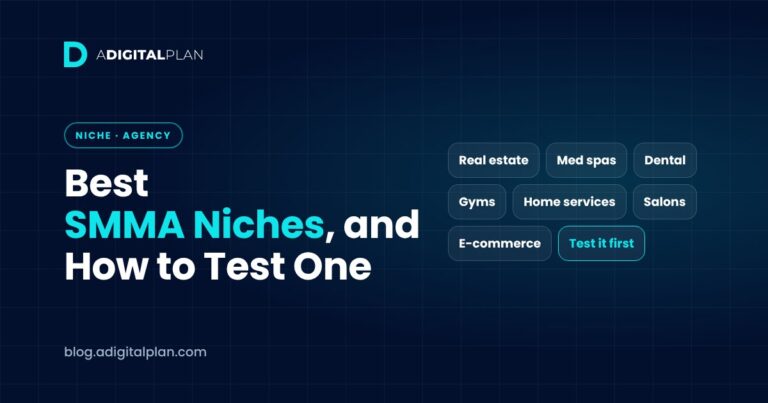
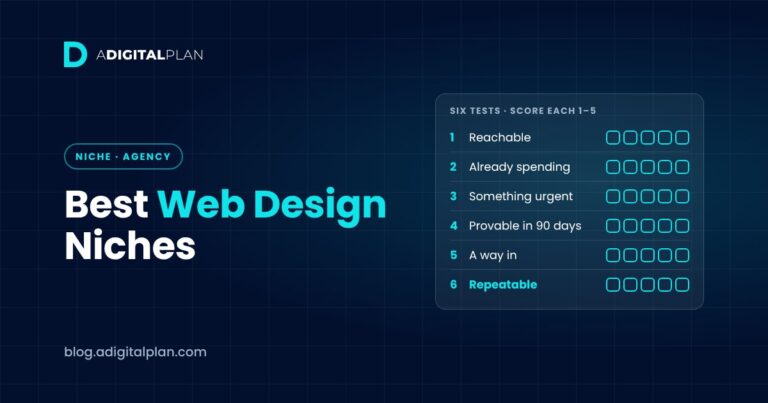
“Local businesses” on its own is too broad. Narrow it to one type in one local area and it may pass. Passing test 1 is the start, not the answer. Run the other five before you treat any example as yours. For social media agencies specifically, we test common candidates in the best SMMA niches and how to test one. Web designers can use our guide to choosing a web design niche.
What about the most profitable niche?
There isn’t one that holds for every agency. A revenue figure someone posted on a forum tells you what happened to them, with their history, contacts and proof. It won’t tell you what would happen to you.
A niche you can reach, prove a result in and repeat will usually do more for you than a “lucrative niche” where you have no proof and no way in. Reddit and forum threads are worth reading for ideas and for owners’ language. Treat their rankings as candidates to test, not answers.
Industry niche or service niche?
There are two ways to niche a marketing agency. An industry niche picks the market: dental practices, accountants, home services firms. A service niche picks the work: local SEO, social media marketing, email marketing, paid ads or content creation, sold to anyone.
Service niches are easier to start, because the skill travels with you. They’re also harder to stand out in, because every other digital marketing agency offering that service is your competition. Industry niches take longer to choose but give you a list, a language and case studies the next client recognises.
Many niche marketing agencies end up combining the two: one service for one industry. “Local SEO for independent dental practices” passes test 1 and tells a prospect exactly what you do in one line.
How a niche changes your own marketing
Once you’ve chosen, your agency’s own marketing efforts get simpler, because every piece now speaks to one market:
- Your own website. The homepage names the niche, and each service page and landing page uses the phrases from your language list rather than generic online marketing terms.
- Keyword research. Your target keywords become the searches your niche makes, such as “marketing for dental practices”, not broad digital marketing terms you can’t rank for. That’s also a cleaner way to judge website traffic: fewer visitors, but more of them potential customers.
- Content. You create content that answers the questions owners in that industry ask, which builds industry presence faster than general marketing advice.
- Referrals. Businesses in one industry talk to each other at trade events and in professional groups, so word of mouth has somewhere to travel.
- Outreach. A named list of businesses in one industry makes every message specific. Here’s how to win clients with or without cold outreach once your niche is set.
- Delivery. When the second client buys roughly what the first bought (test 6), you can build systems once: onboarding checklists, reporting templates and standard processes you reuse for each new client.
What a niche won’t do on its own
A niche doesn’t guarantee premium rates, higher conversion rates or recurring revenue. It makes them possible, because deep expertise in one market is easier to explain and easier to price. You still have to earn the first referenceable result, and that’s why test 4 matters so much.
Specialising also means learning the market properly: its seasonality, its regulations, how customer lifetime value works there and what decision makers in that industry are measured on. Plan to review your niche once a year against the same six tests, not once a month when enquiries are quiet.
Frequently asked questions
What is the best niche for a marketing agency?
The best niche for a marketing agency is one you can list, prove a result in within 90 days and already have a way into. No outside list can tell you that, because two of those depend on your own history.
Which niche is best for digital marketing?
The same six tests apply to every digital marketing services business. No niche is best for everyone, so run the tests on candidates from your own history.
What is a digital marketing agency target market?
It’s the niche you choose: one market you can list. Inside it, your ideal client is the specific kind of business your marketing strategy is built around, described in four parts.
Do I need clients before I choose a niche?
No. Jobs, freelance work and industries you know from outside work all count, and they often produce stronger candidates than a client list.
Does niching mean turning work away?
Yes. Write down exactly which work before you announce anything. A positioning line you contradict within a month is worse than none.
Can an agency have multiple niches?
It can, but each one needs its own list, proof and message, which is the cost niching is meant to remove. Commit to one first.
How long does choosing a niche take?
About 20 minutes on your history, an hour on the prompts and one evening on the checks.
Choose your niche with the free course
The free Agency AI Niche & ICP Finder course gives you four lessons (three teaching lessons and a live demo), six plain-English Claude prompts, a prompt pack and an SOP. You finish with one chosen niche, a four-part ideal client and a positioning line, all built from your own history. It’s free for life, needs no card and nothing to install, and suits agency owners from beginner to expert.